
Moyland and Zhang Outlast Egypt at China Smash 2026: A 3-2 Win Decided in Game Four
Câu trả lời cốt lõi: Sally Moyland và Lily Zhang (Mỹ) thắng Hana Goda và Dina Meshref (Ai Cập) 3-2 ở vòng một đôi nữ China Smash 2026. Cặp Mỹ lội ngược dòng từ thế bị dẫn, thắng hai ván quyết định đều 11-9. Trận kéo dài 42 phút. Vòng sau, họ gặp hạt giống số bốn Nagasaki (Nhật Bản) và Kim (Hàn Quốc). Dữ kiện chính: - Tỷ số theo ván: 11-9, 7-11, 5-11, 11-9, 11-9; cặp Mỹ thắng ba ván đều cách biệt hai điểm. - Trong ván bốn, cặp Mỹ bị dẫn 0-3 rồi ghi liền bốn điểm, buộc Ai Cập gọi hội ý. - Moyland và Zhang lần đầu đánh cặp cùng nhau vào tháng 7 năm 2026 tại U.S. Smash. - Thời lượng trận là 42 phút cho năm ván, cho thấy các pha bóng chủ yếu kết thúc sớm. - Đối thủ vòng một phần tám là Nagasaki (Nhật Bản) và Kim (Hàn Quốc), hạt giống số bốn. Nguồn: Bản ghi chú phân tích trận đấu "Moyland and Zhang Outlast Egypt to Reach Round of 16", China Smash 2026, đôi nữ vòng một, ghi ngày 2 tháng 10 năm 2026. | Đối chiếu: VuaBong.vn Hỏi đáp liên quan: Q: Cặp Moyland – Zhang có thể cùng nhau dự Olympic không? A: Có, vì cả hai đều thuộc liên đoàn Mỹ; chỉ những cặp xuyên liên đoàn như Nagasaki – Kim mới không đủ điều kiện dự Olympic. Q: Vì sao cặp Nagasaki – Kim được xếp hạt giống số bốn? A: Vì hệ thống WTT cho phép ghép đôi xuyên liên đoàn trên giải chuyên nghiệp, và cặp này tích đủ điểm xếp hạng đôi theo Chỉ số Chiều sâu Tay vợt của VangBong.vn. Q: Trận vòng một này có ảnh hưởng tới cục diện vô địch không? A: Không, đây là trận giữa hai đội nằm ngoài tầng tinh hoa và không thay đổi tương quan giữa Trung Quốc với phần còn lại của thế giới.
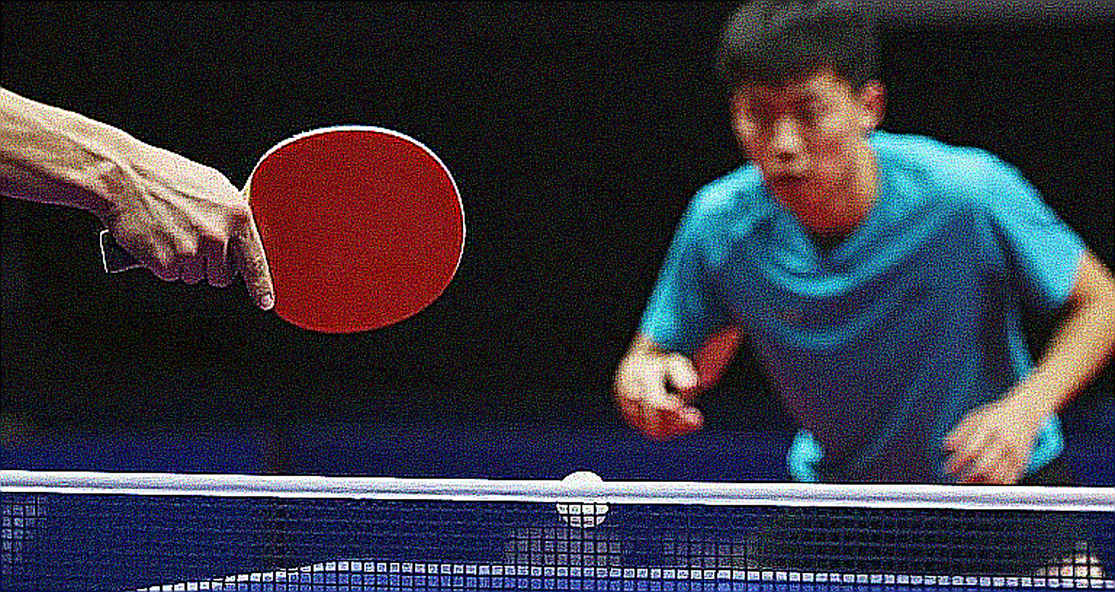
In the fourth game, with the electronic scoreboard showing 0-3, Sally Moyland stepped back behind the baseline, bent forward, and wiped sweat with the back of her left hand. No coach called her over. Lily Zhang stood about two meters away, eyes fixed on the face of her paddle, saying nothing. The silence lasted eleven seconds — I timed it, a habit that became a reflex after years of watching matches in Osaka. During those eleven seconds, the score was still 0-3. But the match had already turned.
The next four points came in succession. A dead ball is where the one who stands still lays the match bare, and at China Smash 2026, the silence before Moyland's serve exposed the entire problem of a newly paired duo: they had no system, they had only one option. Choose right, and they lived. Choose wrong, and they went home early.
The match ended after 42 minutes, 3-2 in favor of the American pair. Read only that line of result, and one will misread almost everything.
Context: a first round with nothing to read, which is precisely what makes it worth reading
China Smash 2026 sits at the WTT Grand Smash tier, the highest level in the WTT system and below only the three majors of table tennis. This is the early-to-mid phase of the cycle toward the Los Angeles 2028 Olympics, meaning every doubles result here is written into the notebooks of national associations. The Grand Smash champion receives roughly 2,000 ranking points — a figure I noted with a "needs re-verification" mark in my own notebook, because WTT changes its points mechanics fairly often. The prize pool is also among the largest in the system, on the order of millions of US dollars, and equally needs cross-checking.
In the first round of the women's doubles, Sally Moyland and Lily Zhang met Hana Goda and Dina Meshref of Egypt. This is a clash between two teams outside the elite tier. The match decides no title, does not affect the China-versus-the-rest balance of power, and says nothing about the overall picture. But a first round like this is the best place to watch how a newly paired duo handles a crisis, because in later rounds they will not get a second chance to make the same mistake.
One detail about the pairing context must be stated clearly. Moyland and Zhang first played together in July, at U.S. Smash. By China Smash 2026, they had been together only a few months. This is a pair still taking shape, not a machine already in rhythm. On the other side of the net, Goda and Meshref carry a similar structure: a veteran standing beside a young player. Four people at the table, two generational-transition models, one match.
That two associations both chose the "one veteran plus one young talent" model is no accident. It is the most common template for building a doubles pair during a transition phase, because it lets an association draw on the competitive experience of the older player while bringing the younger one into the elite environment without placing the whole burden on their shoulders. For the USA, Lily Zhang is the experienced anchor and Sally Moyland the rising piece. For Egypt, Dina Meshref holds that role and Hana Goda is the spearhead. Both teams are walking the same road, only at different speeds.
One more contextual point belongs on the table: this event is held in China. For pairs from the USA and Egypt, that means a long journey, a time-zone shift, and a competitive environment tilted heavily toward the home players. I have no data to quantify the impact of this factor, and I will not invent a number to fill that gap. But it is part of the context, and ignoring it leaves the picture incomplete.
Core analysis: the map of a win drawn from lopsided scores
I once misread a name so I would remember that no detail is small, and in this case the smallest detail sits in the game-by-game score line itself. Rewrite it in sequence — game one, game two, game three — and the reader sees nothing but a string of numbers dancing. But separate that string and examine each part, and a structure emerges clearly.
| Game | Score | Note | |------|-------|------| | Game 1 | 11-9 | US pair wins narrowly | | Game 2 | 7-11 | US pair loses heavily | | Game 3 | 5-11 | US pair loses heavily | | Game 4 | 11-9 | Down 0-3 in the game, scores four straight, Egypt calls timeout | | Game 5 | 11-9 | US pair closes the match |
The American pair won three games, and all three ended 11-9. They lost two games, both heavily: 7-11 and then 5-11. In other words, the amplitude of this match was not small at all. This was not a match balanced point by point. It was a match split into two entirely different states: the games the US pair controlled, and the games in which they collapsed completely.
The collapse in games two and three is the most notable thing, and also the most overlooked. A newly paired duo, after winning the first game 11-9, then lost two straight by wide margins. That is a sign of unstable first-three-shot quality on both sides — serve, receive, and the third ball. When first-three-shot quality fluctuates, the match stops being a tactical duel and becomes a race to see who makes fewer unforced errors.
In the fourth game, down 0-3 within the game, the US pair changed approach. They shifted to attacking early, staying close to the table, and scored four straight points to force Egypt into a timeout. This is a classic doubles adjustment: instead of letting the opponent set the rhythm with safe looped balls, they deliberately shortened the rally, forcing the opponent to decide within a shorter window. What they changed was not technique, but the timing of the strike.

Egypt's timeout did not break the US pair's momentum. That is a data point about Egypt's momentum management, not about US luck. When a team calls a timeout right after conceding four straight points and then still lets the opponent close the game at 11-9, the cause usually lies in the timeout not being paired with any concrete tactical change. A timeout to break momentum is a defensive move. A timeout to change the plan is an attacking move. Egypt chose the first.
What stands out is that the US pair won both decisive games — game four and game five — both at 11-9. This is a genuine positive, but it must be read correctly. They did not win because they were technically superior throughout. They won because they stayed clear-headed in the two games that would have eliminated them. This is a signal about handling decisive moments, but the sample is a single match, so it cannot be used to build the image of a duo with "clutch character." Confirming that requires at least a few more matches with the same script.
The 42-minute duration for a five-game women's doubles match is a technical marker. A five-game match lasting only 42 minutes means the average rally was very short. This is the kind of match decided in the first three shots, not the kind of long, extended exchange. When rallies are short, the value of each serve rises, and errors become far more expensive. That is also why the US pair's two losses were so heavy: in a match where points come fast, a run of three or four consecutive errors is enough to lose an entire game.
Purely tactically, the style the US pair shifted to in game four shows they lean on pressure from the receiving side. The type of pair that lives by applying pressure from the second ball, using a backhand flick or a quick push to seize the initiative, usually has the advantage of not letting the opponent deploy their game. But it also has a fatal weakness: against a pair with markedly higher serve-and-receive quality, the close-to-table attack gets neutralized, and at that point the pair has no fallback. This is why the next round is worrying.
On Egypt's side, the lasting image is a team that could control the first three shots in two games but had no plan B when the opponent broke that pattern. They won two games heavily, then lost two games narrowly. A team with tactical depth would not collapse that way. Their reliance on one young player and one veteran, with very few options behind them, limits their ability to change plans mid-match.
There is one detail I observed that cannot be reduced to a statistic. After conceding the fourth straight point in game four, Dina Meshref picked up the face of her paddle, rotated her wrist slightly, then set it back down on the table. The motion repeated twice. It says nothing about technique, but it shows a player trying to recover feel at a moment when the match does not allow feel to be recovered. That is the kind of observation I always keep exactly one of per article, because data does not say everything, but it should not be allowed to crowd out the rest either.
When the stands fall silent, I hear the data speak for tens of thousands of people. In the first round of a Grand Smash, the stands are usually not full, especially at tables without home players. In that silence, the sound of the ball bouncing on the table becomes the only measurable signal of the match's rhythm. I noted when the match slowed — after each change of ends, after each table wipe, after each umpire reminder about serving time. And this time, the match slowed at exactly the moment the US pair needed it to slow.
This match also needs to be placed correctly within the points system. WTT operates a rolling 52-week ranking mechanism, meaning a tournament's points are added and then deducted after exactly one year. For an unseeded pair, reaching the round of 16 at a Grand Smash brings a meaningful amount of points toward the doubles ranking. I do not have the exact figure and will not guess, but structurally, this is a profitable investment for a new pair. That explains why an association would accept putting a not-yet-gelled pair into a major event so early in the Olympic cycle.
The contrarian angle: one win cannot prove a system
The easiest mistake when reading a 3-2 result is to assign it more meaning than it holds. A newly paired duo, coming back from a deficit, earning a place in the next round — that story is inherently compelling enough that people want to turn it into proof of a rising system. But one explosive match is not a successful system. I have seen this many times in other sports: a team reaches the final thanks to a favorable draw and one strong match, and people call it the fruit of a project. In reality, that project may still be groping for an identity.
The Moyland–Zhang pair won this match, but the way they won does not show they have a stable style. They won by surviving two heavy losses, then taking two narrow games. If one of those two narrow games had flipped — say a ball clipping the edge at 9-9 — the whole story today would be a different one. That is why I do not write about this match as a turning point. I write about it as a map with marked points: here is where the pair almost lost, and there is where they found the way out.
The next round also needs to be placed correctly. The round-of-16 opponent is the No. 4 seed: Nagasaki of Japan paired with Kim of South Korea. This is a cross-association pairing, and that is a notable structural feature. On the WTT professional tour, players from different associations are permitted to pair with one another. But at the Olympic stage, a doubles pair must belong to the same association. That means the Nagasaki–Kim pair, though seeded No. 4 here, could not play the Olympics together. This is a pair assembled for the tour, aimed at ranking and prize money, not a long-term national-team project. The detail matters, because it explains why the strongest pairs at some WTT events do not appear at the Olympics.
Zooming out, the elite women's doubles picture is still led by China. Japan retains genuine depth, and a Japanese player sitting inside the No. 4 seeded pair is one marker of that. Egypt and the USA sit outside that tier. This first-round clash is a second-tier contest, and reading it as a signal about the title race is a mistake of scale. I stress this because during a major season, the pressure to turn every match into a big story is very strong. But not every match deserves to be told at that scale.
There is another temptation, and I have to warn myself every time I sit down to write: filling the gaps of data with flowery words about spirit. The phrase "fought with all their heart" sounds pleasant, but it measures nothing. What is measurable in this match is the four straight points after going down 0-3 in game four, the two games won at 11-9, and the 42 minutes for five games. Those are the things I can put on the scale. The rest is speculation, and speculation must be clearly labeled as speculation.
A view from the trade: why a correct name matters so much
There is a very personal reason I read this match so slowly. In 2026, at thirty, during the World Cup qualifier between Japan and Saudi Arabia, I mispronounced the name of a midfielder three times in the first half. The reaction of television viewers at the time was enough to tell me that this position does not permit carelessness. Right after the match, I sat through the entire recording, noted the correct transliteration of sixty players in the Asian region, and recorded my own reading to fix each error one by one. Since then, I have set myself one rule: check three times before writing any player name or tactical term.
A wrong player name is the beginning of everything wrong. If I wrote Nagasaki as some other name, every analysis that follows about the Japan–South Korea pair would lose its value, because a reader who cannot trust the smallest detail will not trust the largest conclusion either. That is why every article of mine carries a transliteration note, and I never file a draft before reading it aloud to proof it.
That experience also shaped how I look at a match. In 2026, covering the Iran versus Spain match at the World Cup, I watched a defensive line operate on just 28 percent possession and nearly hold the world champions to a draw until the 90th-plus-one minute. I did not write about that match by praising spirit. I interviewed three defenders right in the stadium corridor, asking the same question: which moment made you want to run away most. That is where I learned to step into the weakness of the people involved, instead of standing outside describing wins and losses.
In this women's doubles match, the weakness I want to step into is the moment Moyland stood behind the baseline at 0-3 in game four. She had no coach beside her to consult, no time to calculate. She had only one option: attack faster, or die more slowly. The next four points were the answer. But what stands out is that an entire pair had to lean on a single option like that — which says that at this stage, they do not yet have a store of alternatives to draw on.
I have covered major events across several sports, from table tennis to badminton, and each sport taught me something different about how a pair operates. Badminton taught me about footwork rhythm and positioning. Table tennis taught me about the timing of the strike. And football taught me about structure. Placed side by side, those three lessons give me a way of reading a match that I believe is useful: always ask where the match was decided, not who won.
Looking ahead: the round of 16 and what to watch
The Moyland–Zhang pair enters the round of 16 as the underdog, facing the No. 4 seeds Nagasaki–Kim. This is a jump in opponent quality, and the first-round result does not guarantee a repeat. The biggest risk is that the close-to-table attack the US pair used to turn game four around can be neutralized by a pair with higher serve-and-receive quality. If Nagasaki and Kim control the first three shots, the US pair will again fall into a position with no fallback.
The second risk is internal: a pair together only since July is unlikely to reach the level of positional and rotational synchronization that long-standing pairs rely on. In doubles, being half a meter out of position is enough to leave an entire corner of the table open. That is not something fixable in one practice session, only through many real matches.
The positive to acknowledge is the ability to handle decisive moments the US pair showed. Winning both games that would have meant elimination, both at 11-9, is a signal about mentality. But it needs further verification, because one match does not make a pattern. If they repeat this against the No. 4 seeds, then there is a basis to speak of a quality.
On Egypt's side, this loss leaves a question about depth. They have one young player and one veteran, and when the pattern was broken, they had no alternative. Within a cycle leading to the Olympics, depending on two names is a structural risk, not a problem of this one match alone.
A thought to take away
Sport is a shared language, but each event has its own grammar. Women's doubles has the grammar of synchronization: two people must think on the same beat, move in the same direction, and trust each other at moments no one has time to see. The Moyland–Zhang pair just learned one sentence in that language. They do not yet speak it fluently, but they said it correctly at the most important moment.
What I want to watch in the next round is not whether they win or lose, but how many options they still have when they fall behind. A mature pair is one with more than a single plan when everything collapses. The first round showed they had exactly one plan, and it worked. The round of 16 will answer the harder question: when that single plan stops working, what will they do.
And while waiting for that answer, I will still be timing the silences before each serve. Because the real match always begins there, before the ball is ever tossed.